Void-fill machine integration: much more than just buying a machine
Key takeaway: integrating a void-fill machine is not about putting it next to a table. It means designing an ergonomic packing station where the machine, the rolls, the worktop and the operator work as a single system. At FACT, we don't sell a machine, we design and manufacture the complete integration: adjustable workstation, suitable machine support, consumables management, preliminary ergonomic study. It is the difference between a workstation that is saturated after 18 months and a system that runs for 10 years without friction.
Buying a void-fill machine is easy. Integrating it properly is a craft. Most workshops that invest several thousand euros in a machine put it on a spare trolley, squeezed between two sets of shelving, 3 metres from the packing area. The result: the operator twists, loses time, gets tired, and the return on the investment collapses. FACT has been designing and manufacturing custom integrations for over 20 years that turn the void-fill machine into a genuine productivity lever.
Why void-fill integration determines 80% of your productivity
We tell the customers who visit our workshops again and again: the machine is 20% of the result. The integration is the other 80%. A well-designed workstation turns a tool into a system.
The machine alone solves nothing
A void-fill machine placed on a makeshift support is a classic strategic mistake. The operator has to go and fetch the void-fill, come back to their table, adjust, wedge, and pick the parcel up again. With every operation come micro-movements, twisting of the torso, wasted gestures.
On a single parcel, it seems negligible. Over several hundred parcels a day, it becomes a permanent drain on productivity. And over a full year, it is the equivalent of several weeks of production lost per workstation.
The worst part is that it is invisible. Nobody knows how to measure the time lost in wasted movements. You put up with it, you get used to it, you accept it. Until the day a better-equipped competitor wins the contract.
The packing station must be designed as a whole
A high-performing packing station is a coherent system where every element serves the operator's movements. The void-fill machine must be at the right height, on the right axis, with the consumable rolls accessible without moving.
The worktop must receive the parcel to be prepared without the operator having to twist their back. Secondary consumables (tape, labels, delivery notes) must be in the immediate reach zone.
When everything is in its place, the movement becomes fluid. The operator no longer thinks about the tool, they think about the parcel. That is when productivity takes off.
Ergonomics as a pillar of profitability
Ergonomics is not an optional comfort. It is a hard profitability criterion. A poorly designed workstation causes fatigue, fatigue causes errors, errors cause returns, and returns destroy the margin.
Conversely, a well-integrated workstation reduces fatigue, stabilises the pace and makes quality more reliable. The chain holds together. And on a more human level, the operator finishes the day less worn out, with a lower risk of MSDs in the long term.
A successful integration is therefore a double return on investment: financial and immediate through productivity, human and lasting through prevention.
Expertise, design, manufacturing: our 4-step approach
FACT never delivers a standard integration straight out of a catalogue. Every project goes through our rigorous industrial methodology, designed to guarantee a result that is ready to use from commissioning.
The on-site ergonomic study: the foundation of everything
No serious integration can be carried out without an analysis of the real flow. Our technical teams visit your site, or work remotely from photos and measurements, to understand your context: type of parcels, target throughput, number of operators, available floor space, dispatch constraints, consumables supply flow.
We ask the right questions. Who are the operators? Left-handed, right-handed? What are the largest and smallest parcel sizes handled? Every answer shapes a design decision.
This study is free of charge. It does not commit you to ordering. It serves to confirm or rule out feasibility before we even talk about price. It is our way of working: we think about the problem before talking about the product.
Custom 3D design
Based on the study, our design office creates a complete 3D drawing of your integration. You see exactly what will be manufactured: frame, dimensions, accessories, positioning of the machine, rolls and consumables.
This is the critical approval phase. Anything overlooked here is paid for in cash during operation. A badly taken dimension, a poorly thought-out angle, a forgotten cable route, and it is the operator who suffers for 10 years.
The 3D drawing is presented to you, discussed and adjusted if necessary. Nothing goes into production without your written approval. This rigour protects both parties.
French manufacturing: the guarantee of durability
All of our integrations are manufactured in our workshops in Dagneux (01), France. No distant subcontracting, no containers stuck in port, no flat-pack kit to assemble like imported furniture.
Our frames are made of welded steel, finished with high-resistance epoxy powder coating. Worktops are 22 mm melamine-faced board, with a stainless steel sheet option for demanding environments. The standard load capacity is 450 kg. This is not furniture, it is industrial equipment.
Local manufacturing also guarantees after-sales service. A part to replace? We make it. A change to the workstation? We study it. The equipment lives with the company, it does not become obsolete at the first change to a process.
Support: advice, not hard selling
Our teams are technicians, not pure salespeople. Their role is to understand your need and propose the best solution, even if that solution is simpler or cheaper than what you first imagined.
A good adviser also says "no" when needed. No to an integration oversized for your volume, no to an accessory that won't be used, no to a configuration that will eventually get in the operator's way. This is where the relationship of trust is built.
Integrations suited to every scale
A void-fill integration is not necessarily a huge packing line. We work just as much on large logistics platforms as on small businesses that are rapidly scaling up.
Large integrations in logistics areas
For e-commerce warehouses, distribution hubs and 3PL platforms, we design large-scale integrations. Several workstations in a row, dispatch conveyors, centralised consumables management, integrated LED lighting, motorised adjustment with memory presets for each operator.
These projects are studied on an overall plan. Zoning, traffic flows, roll supply, removal of finished parcels. Every square metre counts. So does every second of the cycle.
On these installations, standardising the workstations is critical. Operators rotate, teams change. A workstation must be usable by anyone, immediately. This is where the memory functions and modularity really come into their own.
Compact integrations for small and medium-sized businesses
At the other end of the spectrum, we also integrate void-fill machines onto a simple Ergologic® workbench. One workstation, one operator, a few dozen to a few hundred parcels a day. The need is different, the rigour of the integration remains the same.
For these configurations, the challenge is to maximise the versatility of the workstation. The workbench must be able to serve for packing, inspection and preparation, with the void-fill machine integrated but not intrusive.
Ergologic® modularity really comes into its own here. Over 100 compatible accessories, perforations every 40 mm around the entire perimeter, and the ability to add or remove elements without tools. The workstation evolves with your activity.
Intermediate configurations
Between the two extremes, most projects fall into an intermediate zone: 2 to 10 packing stations, a sustained but variable pace, an e-commerce seasonal peak or regular B2B activity.
For these configurations, the central question is the consistency of the whole. All workstations must speak the same technical language, share the same accessories and allow an operator trained on one workstation to work immediately on another.
This is exactly what the Ergologic® range makes possible. A single logic, available in as many variants as needed.
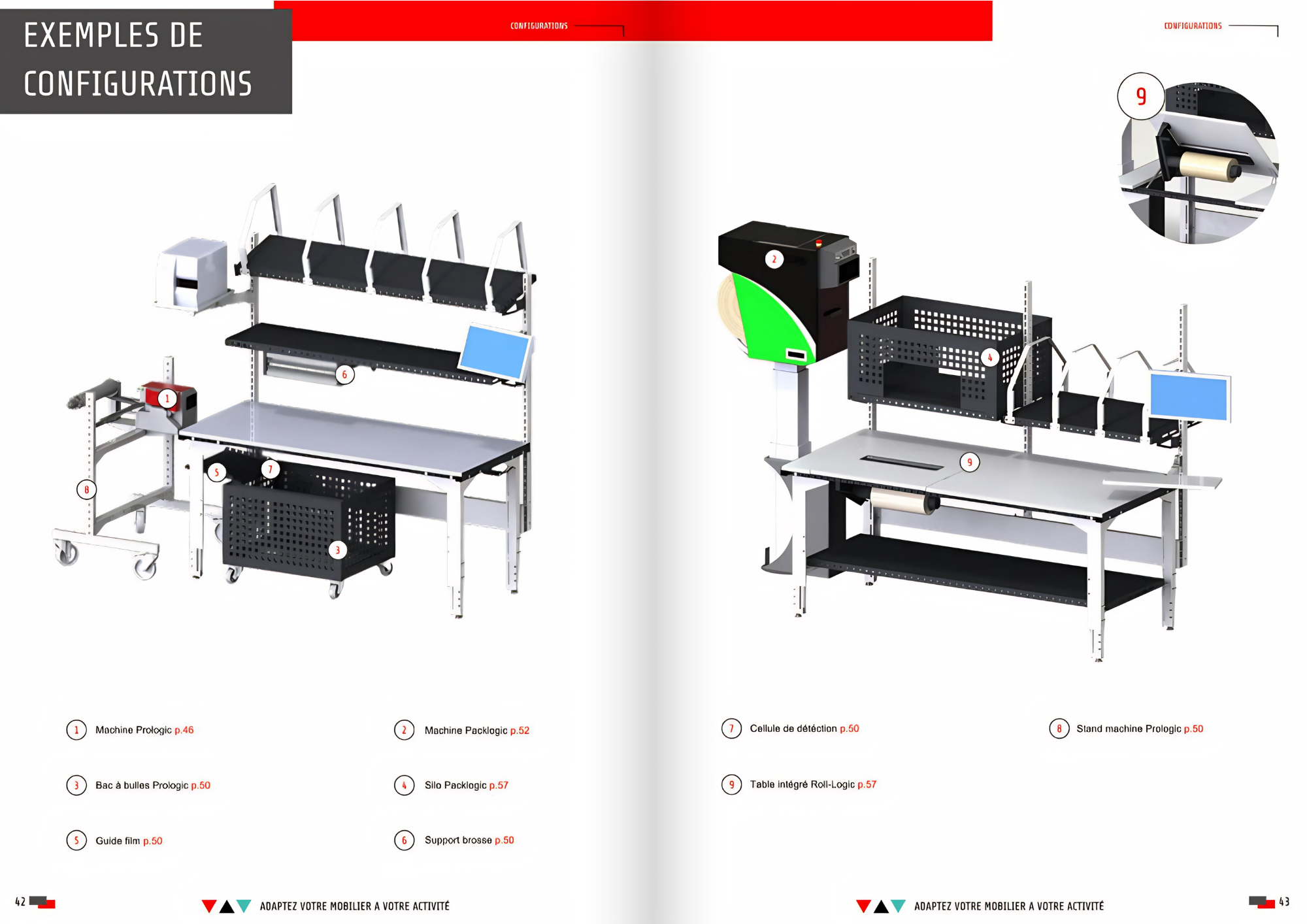
Prologic and Packlogic: two specialities, one standard
To meet the two main families of void-fill used in industry and e-commerce, we have developed two dedicated integration ranges. Each one is optimised for its type of machine.
Prologic: integration for air cushion and bubble wrap void-fill
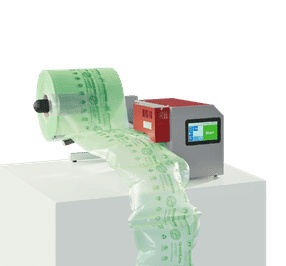
The Prologic range is designed for integrating air cushion and bubble wrap void-fill machines. These technologies are particularly well suited to protecting fragile products, electronics, high-value items and cosmetics.
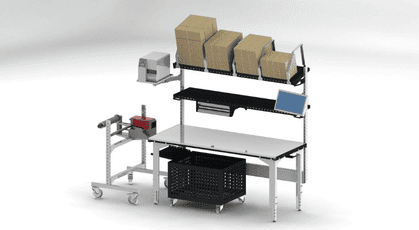
The Prologic workstation is designed to handle the smooth delivery of inflated void-fill or bubble wrap rolls, with an ergonomic layout that spares the operator from moving between the parcel and the machine.
Packlogic: integration for paper void-fill
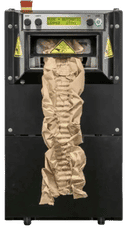
The Packlogic range is dedicated to integrations around paper void-fill machines. This technology is favoured by companies committed to reducing plastic packaging, for environmental or brand image reasons.
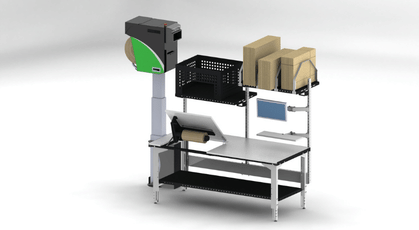
The Packlogic® workstation is specifically sized for handling crinkled or embossed paper, with suitable roll holders and a layout that smooths the void-fill movement.
The choice depends on your constraints
Between Prologic and Packlogic, the choice depends on your type of products, your packaging policy, your budget constraints on consumables and your environmental commitment. Our teams guide you impartially towards the most relevant solution for your case.
It is also possible to combine the two in the same warehouse, with specialised workstations depending on the flows. A Prologic workstation for fragile products, a Packlogic workstation for everyday products. The consistency of the Ergologic® structure makes this flexibility possible.
Request a study and a quotation for your integration
Every integration project starts with a discussion with our technical teams. Whether you are a large logistics warehouse to be equipped across several workstations or a single-operator workshop that wants to professionalise its packing, the process is the same.
You contact us and explain your context and constraints. Our teams ask the right questions, analyse feasibility and propose an initial technical direction. If the project moves forward, we carry out the in-depth ergonomic study and deliver a detailed 3D drawing together with a precise quotation.
At no point do you pay for us to think. The study and advice are free of charge. You only commit when you approve production.
To get started, there is just one step: get in touch with our technical team. We will reply within 24 working hours, with a single point of contact who will follow you from the first discussion to delivery of the workstation on site.



.png)